Skip to content

Heather Ellis

Drifting away from being just another carbon copy…

Here is Alan’s ISAAC Paper…..

Abstract (135 of 150 max)

Whilst growing up, it was my dream to have an electronic AAC device that would enable me to talk more to people on my own.  Following several trials of numerous devices, I have only found one that comes close to meeting my needs. Unfortunately, it was best suited to a static environment and limited my ability to talk to people on the move. I have found that my wordboard is still the best for portability. Another main issue that I experienced has been that the devices are slower for me to use than my wordboard. As a result, I have begun work on a project to merge the wordboard and an electronic device to create a more portable communication system for myself.  Hopefully this will result in a more portable and faster means of communication.


Proposal(967 of 1000 max)

When I was little, I had a dream. My dream was to have a portable communication device to help me to talk to people on my own. In 1986, I got a similar device called a Vois 135. At the time I really liked my machine, as it was the first time I was able to talk on the telephone. It also helped me to talk about hobbies and bands that my friends and I liked at school. This device was what really opened the door for me, giving me more independence. I had the Vois 135 for around eight years but I found that the device was too bulky and awkward to move around with. Despite the fact the fact that I have always used a wordboard, which was great to take everywhere, it had three main limitations. Firstly, as it is not able to output sounds I am unable to talk on the phone using it. Secondly, I cannot communicate with the driver when we are going on car trips. Lastly, reading the wordboard in the dark is almost impossible. What I really needed was to find a smaller, more portable device much like the wordboard, which had the electronic capacity of the Vois 135, which would increase my ability to talk even more. This was my dream.

Last summer, whilst at an AAC conference in South Africa, I was asked why I use such a low-tech device when there is a wide variety of higher – tech devices available for AAC. Although I would like a higher-tech device after having tried and tested a few, my wordboard is still the only one that best meets my needs. The first time I came across a portable, electronic AAC device was at a previous ISAAC conference with a colleague of mine.  After using it for an hour, I decided it was useful for me and similar to what I had been searching for. After returning home from the conference, I told my therapist about the exciting product I had seen. She said that she would try and get it for me to try out. After a short period, my therapist managed to get me the device on a trial basis. As I grew to like the device, I asked my therapist if I could keep the device as my own and finally it was mine to keep. The device greatly increased my ability to communicate giving me the freedom to talk on the move. As a result I tried to use my wordboard less relying more on the device for my communication. After about a year of use, I found I was not able to use the device quick enough to keep up with the conversations. I was still faster on my wordboard and I found people were more engaged in the conversation when they had to interact on a deeper level with me. The device was really good but after about three years it kept breaking down which meant that it had to be sent away to be fixed, leaving me without my communication device for around a month at a time. I still had my wordboard though. My therapist suggested that I invest in a different device that was more reliable than my current one.

My next device was a surprise purchase by my therapist, which worked well in theory, but in practice it wasn’t so good. The buttons were quite small making it difficult for me to select the right letter I wanted. Again, I found communicating with the device was slow. Due to the electronic voice, it reduced my engagement with the person I was talking to and the time I spent interacting with my device increased the chance of person thinking the conversation was over and saying good-bye leaving me half way through my sentence.  My wordboard, however, allows me to interact more with the people I am talking to and reduces the chance of someone misinterpreting the end of the conversation.  In my opinion, the wordboard increases interaction between two people in conversation through eye contact, a feature that is often absent from a conversation using an electronic AAC device. I often find that when I use an electronic AAC device the conversation is broken and disjointed as I spend more time with the device instead of interacting with the person.  However, despite the fact that my word board is the best AAC device I have at the moment, it requires more work from the other people in the conversation as they have to stitch together my sentences.

For the past twenty-three years I have been helping develop software for AAC devices in the hope that my experience will help to create a device that is suitable. However, despite all the technology, my wordboard is still the best! I know this is a big problem for disabled people but I have this idea of a device that outputs its sound from nearer my throat using a handheld input device allowing me to properly talk to someone.  In the meantime, I am currently working with a friend and colleague on my idea of trying to merge my wordboard and a portable electronic device to allow me to communicate with a normal conversational flow. With the same colleague, we are also currently developing another one of my ideas of using an interactive map to give non-speakers the chance to talk about their holidays and travelling experiences unassisted to their friends and family. It is hoped that by having an AAC user leading the initial design processes based on their experiences that we could create a more practical and usable device for other AAC users like myself.

In our talk, I will describe how we designed the device together and demonstrate how it works.


Recently I found out that my submission for the ISAAC conference in Pittsburg this summer had been accepted. With this information a mixture of both excitement and nerves set in, I’d have a twenty minute slot in which to entertain a audience! Being only a second year undergraduate, this was my first submission to a conference  so a feeling of pride filled me as I read the acceptance letter. I have been working as a carer for nearly a year now and wrote the conference paper on what that job means to me. In my paper,What it means to be a carer, I discussed how my own presumptions – despite having two close relatives who are both mentally and physically disabled – were proven incorrect and how my interaction with the individuals have changed as I see the world from a different perspective.

Unlike many of my peers, I have been brought up around people who are struggling in life for a variety or reasons so would like to think that I am more open minded than some. Having grown up in a third world country, I have watched first hand, the suffering of the less fortunate that others have only seen on TV. I have watched my brother slowly deteriorate as he becomes more dependent on my mother for the most basic activities and I have watched as my aunt had her world tipped over when she had a car accident resulting in her becoming paralysed from the neck down. Basically, I’m not new to people suffering or struggling to do what I do so easily in my day-to-day life. Working as a carer, however, has made me see things slightly differently. Having to help Alan (the person I assist) to communicate with, quite frankly, this prejudiced society, has made me realise that communication is one of the most vital traits of being who we are. Our personalities are reflected in both our speech patterns and our voices, our accents a reflection of our past and our wording a reflection of how we feel. My aunt was fortunate enough to still have her full motor control, my brother however, has that but the inability to express himself. Alan, from birth, had limited motor skills and, frustratingly for him, the ability to fully express himself if he can get the right form of communication aid.

Although I wrote my paper as a way of creating a portfolio for myself, the main reason for me writing it was to raise awareness of the struggle that various people undergo. Writing from a carer’s perspective helps to show people what the user themselves may not be able to express. As you can tell from my background, in some way or another, I have been caring for many years. Those who believe that people with disabilities do not deserve the same rights as the ‘average’ people disgust me. What I have seen from those I have been around, although it might take longer to complete a task or they might need some help, they are just as wonderfully creative and capable as the next person. From interesting questions to being a Paralympic swimmer to being a mother of two and helping to run a business, these people remind me why I shouldn’t take things for granted in my life.

In July this year, I will be in Pittsburg presenting this paper and I hope that the audience leave with a new perspective about disabled people. I hope that they see a new person when they look at someone with a disability. Regardless of what life has thrown at us, if we want to achieve something in our lives, we are all capable of it! So wish me luck as I try and entertain a audience for twenty minutes, my longest ever solo presentation. I am a nervous public speaker and don’t fare well in front of crowds, but I will be there voicing my view and trying to shine a different light on what society thinks they know about disabled  individuals.

* Note: Names of AAC user have been changed for privacy

Abstract ( 103 of 150 words max)

My personal outlook on the role as a carer or support worker for a gentleman with Cerebral Palsy and limited motor skills is that it has been an enriching experience. Since we have been working together, I now view society in a different way and am more aware of its prejudices towards those with disabilities. I believe that my time spent with the gentleman has taught me how better to interact with someone with limited communication helping me to understand their daily struggles whilst, it is hoped, helping him to allow society to interact with him the same they would with anyone else.


Proposal (960 of 1000 words max)

As many students do, once I had settled into university I began looking for a part time job. Shortly, an offer came along that was perfect. A gentleman with Cerebral Palsy was looking for a part time carer to assist him during the week in social activities. My interest in society attracted me to this position but I was not prepared for what I would gain from it. Although initially nervous, I quickly realised that Harry (name changed), despite having different needs to myself, was no different. Having grown up with a intellectually disabled younger brother and a quadriplegic aunt, socialising with people with different needs to myself was something I was used to, however Harry’s needs were different .For the first time I would be socialising with someone who could not communicate in the standard way, something that made me wonder how I would possibly be able to communicate with him. That was when I first came across the world of AAC.


Alternative and Augmentative Communication (AAC) is the term given to any other means of communication besides oral communication. The range of devices is quite vast depending on the individual’s needs. Some of the devices can be rather high-tech but Harry’s main form of communication is a word-board. Despite how low-tech his ‘voice’ is, it gives Harry the freedom and independence he would not have had otherwise. Working as a carer for Harry, I have observed that having a potentially isolating disability does not have to result in being excluded from social interaction. From giving talks around the world, being a three time-Paralympic swimmer, making his own music and assisting research students to develop AAC technologies, Harry is an inspiration to many people, myself included.


When we are out, I have noticed that Harry and I get two main reactions from people. Either, I am looked to as an interpreter as Harry is ignored; or the person – with every good intention – over tries. Having grown-up with being treated differently, Harry often accepts it but I struggle with society’s attitude more. I must confess that at times, when unsure of how best to approach a disabled person without causing offense, I have let them pass in the shadows. Many people have been guilty of this at some point of their lives. Working with Harry has made me realise that the best way to approach someone with a disability is, for the most part, just converse with him or her as you would any other person. Being a carer means that I have the chance to help society see disabled people as they would any other person.


At the CAAC Conference in South Africa last year, an AAC user talked about the stigma attached to disabilities. His discussion on terms like ‘wheelchair bound’ was interesting, as I had never given much thought to them before. The terms often have a negative connotation that isolates the individual rather than embrace the freedom the item gives a user. The same gentleman, for example, told me off for talking too much and not letting him have a word in! Often I am reprimanded for this for but without his AAC device, the gentleman would not have had the opportunity to express his opinion. Therefore should we not call these devices empowering as opposed to restrictive? The conference showed me that AAC users are proud of their ‘voices’ and, regardless of the stigma attached to their disability, they would continue to strive towards becoming more of an integrated part of society.


Many people, upon observing the interaction between Harry and I, assume we have been working together for much longer than we have. The human ability to adjust and adapt has always been an interest to me and being a carer has shown me that when you want to achieve something, you can. I believe that Harry and I are able to hold a conversation with a normal conversational flow, something that I would never have thought possible in our first meeting. Often in life we walk by those who are different without taking the time to stop and listen, I’m not letting my work with Harry be one of them.


After the conference we visited Cape Town, South Africa, I am reminded of a steep path curling its way upwards to the sky at Cape Point. At the top of the hill was a lighthouse overlooking a point in the sea where ‘two oceans met’. Since our arrival in South Africa, we were told that if the day was right the view was amazing. Looking up at this hill we decided that it was too steep to use the wheelchair but how could I deny Harry the right to see something that an able bodied person was allowed to see? Unsure as to whether the walk would be too much for him, we started out on the half a mile walk. The walk was slow, my breathing heavy as I supported Harry.  Trudging on, we ignored the people overtaking us. Harry was determined to reach the top and why should he be denied that? Finally, a broadly grinning Harry reached the top. He had climbed his Mt. Everest. The never ending optimistic attitude that he expresses always amazes me and after only a year of working together, I think of Harry as a friend. Whatever title you attach to my position, be it carer, personal assistant or support worker is irrelevant. I have the fantastic chance to work with someone who sees the sun through the rain. To me, this is what it means to be a carer, getting the chance to learn from the person you are working with just as much as you are helping them to lead an independent life.

A constant struggle between the two,
a brain leading forward and a heart  falling.
Monetarily a consensus, a still among the storm -
shortened in its life.
The brain wins again.

She stumbles away,
each step slower as doubt creeps up.
The heart a tortoise in the race,
slowly it catches up.
She turns, flaters -
a wrong decision or the weakness of the heart?

Cold darkness fills the night,
a deep void her only company.
The angel and demon argue -
will she obey her heart and fall again?

She lies awake, the hours dwindle,
watching the sky as it lightens the room.
The constant tick, each tock a reminder of memories together.
A longing to return sets in deep,
the logic is drowning but -
still fighting, she falls asleep.

© Heather R Ellis
February 2012

Late last summer I began considering how best to tackle a challenge posed to me by my mother. A challenge to develop an app for my brother ( An aid in a diminishing world ). Due to university coursework restrictions and constraints, after my intial brainstorm back in August I have only just now been able to create a low-key prototype in the form of sketches. After working alongside my mother to create a set of requirements, I have now attempted to put those functions into a visual representation. Following a user-centred approach I will be working alongside my mother and other individuals to help develop this app into a useful aid for other carers of people like my brother ( The deterioration of an infantile ).

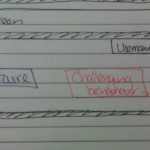
Homescreen of app

The main homescreen

As of yet I have not designed a homescreen and keeping with the process of user-centred design I have not begun coding until I am sure that what I am designing meets the needs of my mother, the ‘client’. From the start I wanted this app to be a clean, simple to use application. Most of the users will be in situations similar to my mother and will be a carer 24/7. Any moment spared will not be spared updating the details of the app if it is a lengthly or confusing process. As a result, I have decided to try and make this a binary process as much as possible. By separating the ‘Seizure’ and ‘Challenging Behaviour’ logs I will be able to speed up the update process. As you can see on the homescreen here I have just a handful of buttons.

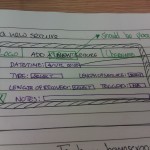
Adding a new seizure menu

Adding a new seizure menu

Likewise, the input variables when adding a new seizure or challenging behaviour incident should be clear and concise, representing only the main options that users will need. Wherever possible, drop-down options should be available to minimise time spent adding a new incident. Creating two colour schemes is hoped to help the user identify which section of the app they are currently in making them less likely to incorrectly add an incident. With regular feedback the user will be able to understand any errors or issues that may arise. It must be noted that some of my scrawled notes relating to buttons on screen are merely brainstorming ideas that I have included.

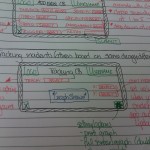
jTrack challenging behaviour graphs

Track challenging behaviour graphs

Finally, the main goal in designing this app is to allow to user to clearly identify the main seizures and their frequency. By providing a concise graph that shows the output of the data entered by the user, they are able to see the trends of various individual seizures against time or against the total number of seizures. It is thought that a line graph may work well but the meeting with my mother will confirm whether this is the ideal form of output.

Although I am fully aware that this app only acts as a method of creating graphs, something that any spreadsheet could do, having this app on a mobile platform will enable the user to have more accurate and up to date information at their fingertips. My mother has expressed a hope that this will help her to monitor my brother’s level of seizure activity and challenging behaviour more efficiently. It is my hope that I am help make this a reality for her and others in her position.

Up and down,

sky and dirt –

the journey does but leap.


From one to another I have but gone –

my stories are but untold.

Tears shed, skins changed,

a new adventure does begin.


Voices rise with each flaming cheek;

eyes leak as one will fall.

Strong against the human need,

I am but a weakling to their touch –

a gentle breath and I do but fall.


Again the confusion follows me,

their true love is not enough.

A decision must be made:

life alone, strong and true or

as a half and weak again?


I doubt my motives –

Can they be true? Sincere?

If I stay I worry it will be a lie –

the need for a companion and nothing more.

Confusion unfolds, temperatures rise.

Melding the bond, they try hard –

oblivious to my stolen snips again.


Perhaps one will appear,

whisk my breath and steal my life.

I do but deny this though –

to give over my half is to great a risk.

For now, I won’t give in.


I am my own,

alone and true.


            © Heather R Ellis

January 2012

Nothing but an agreement –

an unsigned contract of mutual need.

Governed by a trickster,

signed by morons.

The human need of acceptance,

of companionship.


Outspoken claims against it,

cries of pain,

signs of our unified weakness.


Boldly holding two together –

a bond stronger than blood, sometimes.

Trouble in disguise, an allusion of paradise.


Many fall, some prevail –

adapting as humans do.

Evolution in the making.

Chemistry interwoven into DNA –

nothing but a chemical reaction.


Stories told, rumours heard, images shown –

there ain’t no place to hide.

Deep within us lies a craving,

some kill for it, others run.

There is no place for the shades of grey.


A decision made, the new chapter begins.

Flowers strewn upon the ground,

a puddle of ifs and buts.


Exposing us all eventually –

our shells revealed to all.


The great power triumphs again.


© Heather R Ellis

January 2012

As a great lover of nature and natural beauty in the countryside, I have always enjoyed the drives in the United Kingdom but especially around Scotland and Wales. I had never been across to North Wales before so when Alan decided he wanted to see it when we were visiting Liverpool I eagerly agreed. As is the norm of the British weather, we chose a day to travel the two hours to Wales only to wake up to chrome skies and damp paths. Nonetheless we clad ourselves in coats and scarves before climbing into the car armed with a packed lunch and a camera.

As we drove towards the motorway and towards North Wales, the skies got darker and the fog heavier. By the time we saw the first sign for Wales we could barely make it out due to the heavy fog. As we drove along by Colwyn Bay, just passed the Wales border, we acknowledged that there was a body of water there as the horizon was darker and the SatNav indicated there was, else we would never have known. As the rain got heavier and the winds picked up eager to pull my car towards the middle barriers, we discussed turning back. Suddenly, there was a patch of lighter cloud which, as we watched, gave way to a tease of sunlight. As quick as it came it disappeared. It encouraged us to risk it though and keep going, hoping that the rain would subside and take the pesky fog along with it. We were not to be disappointed.

By the time we had entered Penrhyn Bay the sun was filtering beautifully through the clouds and the occasional blue sky was spotted. Taking a drive along the coast we spotted some interesting houses with turrets on them. They were most intriguing designs and colours. We found a cute little parking spot that was overlooking the water on the other side of the bay so pulled in for some lunch. As we watched the seagulls circle above, caught on the air thermals, Zita warned us to keep the windows up as these seagulls were very confident and were known to swoop into cars to steal sandwiches. Now I knew why the seagulls were much larger compared to the ones in Dundee.

Back on the road we headed towards the village of Bets-y-Coed. Stumbling upon a beautiful little bridge over a stream and watching as the sun set between two glens over a body of water was worth dodging the vehicles on the narrow roads. As we pulled into the village we saw the most breathtaking river that had a pretty little island with a massive overhanging tree in it with huge limbs stretching for the sky and caressing the water below. We stopped and watched, mesmerised as the water gushed around the island, over the rocks and diving loudly below the bridge before passing quietly through the other side. Not quite ready to return to Zita’s, we slipped into a little café for a steaming cup of tea and a slice of cake as we watched the last flickers of light disappear from the sky. Still, we could hear the water’s roar as the river rushed along its way to new adventures upon other shores, seeing sights we would not see. Just another day in Wales.

Earlier today I found myself at Birkenhead’s Transport Museum. It showed a lovely transition of transport in the local area. From the early trams right up to the modern buses, the museum showed us it all. Despite being focused mostly on the trams, it also had on display some of the older cars that although I had only seen them in museums before, Alan was excited to see some of the older cars from his earliest memories. As I often do when I am in a museum which demonstrates the transition between generations, I often think of the advancement’s in which we, as humans, have undertaken. Although we now use much faster, expensive and powerful cars they will be more valuable in the coming years as they fade out of existence whilst their predecessors remain ever loyal albeit less powerful.

As Alan and Zita approached a car – which looked to me ‘quaint’ and ‘foreign’ as I had only seen pictures of the car and in movies – he commented that the car was only a little bit older than his childhood. It amazed me that it was still in such a good condition and I supposed that given a little bit of work it would probably run again despite being around half a century old. The common phrases that the elderly say sprang into my mind as so often things made in the early to mid-twentieth century are much better made than the produce of today. As I considered what this meant I was a little sad to think that perhaps there won’t be many museums of today’s produce as it may not be strong enough to survive the coming years. There’s something different about seeing an object from another era in ‘real life’ as opposed through the recreations of movies and it would be a shame that our coming generations may not get to ‘experience’ how the people today live.

As we arrived shortly before the tram was due to run its route we jumped aboard its solid frame that had been restored within the transport museum. Like a child in a toy shop I sat upon its hard wood seats grinning before dashing upstairs to the upper level of the tram to watch the passing sights as we bounced along the rickety route. Comparing those means of transports to what we know now today as ‘public transport’ it is clear that we take a lot of the technology around us in terms of transport for granted. Nowadays we would not settle for the ‘bouncy’ journey that the tram provided but in previous generations this was a ‘revolutionary’ breakthrough. As we become more reliant on these luxuries that our predecessors wouldn’t have thought possible. Makes we wonder about the new exciting technologies that we could start seeing in the coming years.

As the Christmas season approaches Alan had asked if we could visit his girlfriend, Zita, in Birkenhead shortly after my exams. As we drove down towards the south-west of England we began to pass through some of Scotland’s beautiful views. As we whizzed by the mountains in the distance we saw their white topped heads against the bright lively green that was sprouting out from the base of the mountains. Thankfully, this year the snow decided to skip over our little island for the most part so the journey down was relatively smooth and hassle free. Upon arrival in the Birkenhead we ended up spending twenty minutes in traffic!

However, this unexpected extra time gave Alan and I time to admire (or express disgust in) the various decorations on the houses. Some can be rather pretty, but like so many other years, I often think that some people just try too hard to follow the American standards. Most times people can accomplish this and create a pretty scene, however, so often I find that it just looks tacky. There was one house in particular that I couldn’t understand how the people could cope with it, the view or the electricity bill! Just about every inch of their garden was covered in a glowing or flashing statue, the drop lights hung loosely from the roof giving an unkempt look about the house and to top it all off their window looked like it was trying to contain the undying beast within. The horrific rapid flashing that (I assumed) came from their Christmas tree would have sent even the most stable epileptic into a cluster of seizures. How the inhabitants of the house could cope within the flashing lights of the room, I do not know.

Often around Christmas we see acts of kindness and giving, of love and charity but just as often we see acts of egotistic people who greedily populate their houses with excess clutter that simply shows off their wealth and social position. Don’t get me wrong, I enjoy the spirit of Christmas with it’s get togethers and clusters of lights but when you hear of some of the expenses that people are willing to spend only to decorate their houses it’s shocking!

Anyway, enough rants about that, we arrived just as duck was descending upon Zita’s street and the stars were reaching out to us. As we entered the house I was reminded of our last visit to Birlenhead and I settled into my adaption to make the place my temporary home for the next four days. It is my ability to adapt to my surroundings and feel at home wherever I am that I am very fortunate to have and often rely on to make a possibly awkward week more relaxed.